|
Regional Reviews: New Jersey Address Unknown:
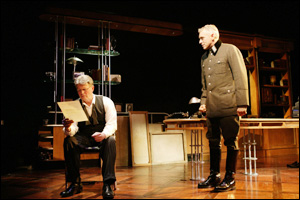
In short order (actually too short order for full believability), Martin turns his back on his friendship with the Jewish Max and totally embraces the new Nazi regime, including its anti-Semitic propaganda. Max's beloved actress sister is trapped inside Germany. When a letter which Max has sent to her is returned to him stamped "addressee unknown," he begins to despair for her life. When Max learns that his sister has died and that her death resulted directly from Martin's refusal to hide her, Max devises a plan to destroy Martin. The "play" is based on a short epistolary novel of the same title by Katherine Kressmann Taylor which was first published in a magazine in September, 1937. The following year, it was published successfully in book form. We are told that it caused quite a stir because it revealed to isolationist America the terror of life in Germany under the rule of the National Social (Nazi) Party. Over the next 50 years, the book had become virtually forgotten. Since it was republished here in 1995, it has been widely published internationally. Published for the first time in Britain in 2002, it was brought to the attention of esteemed director Frank Dunlop who believed that it had theatrical potential. "Edited for the theatre and directed by" Dunlop, it was produced last summer at Manhattan's Promenade Theatre where it only attained a run of about ten weeks or so. It is essentially this production which is now ensconced at the George Street Playhouse. Although Frank Dunlop continues to hold the directorial reins, and the faithful abridgement of the original text remains unchanged, there are crucial, meaningful differences between Address Unknown then and now. I found the Promenade performance to be dramatically inert, emotionally constricted and annoyingly smug about a bit of small, meaningless revenge in a world in which millions of innocent people were being destroyed. The Promenade Martin and Max, William Atherton and Jim Dale, in realistic letter writing fashion, acted in such an understated manner as to leave Kressmann Turner's words flatly on the page of her novel. Why a dramatization when we could more than just as well read the novel/letters in the comfort of our home? Firstly, there is a new ending which George Street's Max, Sam Freed, has worked out with director Frank Dunlop. Without changing a word of dialogue everything which we take home with us from the theatre is powerfully and movingly antithetical to the annoyingly smug and falsely triumphant climax of the Promenade version of this production. Mark La Mura as Martin performs with a passion and intensity that goes a long way toward erasing the inherent untheatricality of a discourse being carried on across the Atlantic Ocean by letter. Max is drawn too negatively too early on by Kressmann Taylor to allow La Mura the opportunity to provide sufficient shading to humanize him (which would make his villainy all the more chilling). However, La Mura does a fine job of channeling the Martin that he has been given. Sam Freed strongly projects the growing anxiety of Max as his lonely world gets turned on its head. He makes believable Max's extreme mood shifts and deep feelings of dread and desperation, nicely fleshing out the the less than three-dimensional Max of Kressmann Taylor's short novel. I don't know what director Frank Dunlop was thinking when he directed such a wan Address Unknown in Manhattan last summer, but he has made a very strong recovery with his present George Street cast. The set designed by James Youmans nicely contrasts Max's art deco furnishings (across stage right) with Martin's ornate European furnishings (across stage left). In sum, Address Unknown is an involving cautionary short story concerning the mercurial nature of the human condition. While neither subtle nor richly layered, it is now an engrossing and lively reminder of a dark era which must be remembered and discussed so that its evils are never repeated again. Address Unknown continues performances through April 10, 2005 (Tues. —Sat. 8 P.M.; Sun. at 2 P.M. & 7 P.M.; Additional matinees: Thurs 3/24 & Sat. 4/2 & 4/9 at 2 P.M.) at George Street Playhouse, 9 Livingston Avenue, New Brunswick; Box Office: 732-246-7717; online www.GSPonline.org. Address Unknown by Kressmann Taylor; Edited for the theatre and directed by Frank Dunlop Cast Max Eisenstein .......... Sam Freed Martin Schulse .......... Mark La Mura
|